Why Texting Is the Best Direct Voter Contact (DVC) Strategy
See why texting beats canvassing, calls, and mail as a direct voter contact strategy.
- Direct voter contact is one-to-one communication between a campaign and a voter, and research links it to higher turnout compared with passive advertising like billboards.
- Texts hit a 98% open rate and are opened roughly 138% more often than email (EZ Texting data), so campaign messages actually get seen.
- 87% of consumers read a new text within 15 minutes (2026 Consumer Texting Behavior Report), which is decisive for time-sensitive GOTV and election-day reminders.
- Texting scales the way canvassing cannot, letting a small team reach thousands of segmented voters at a fraction of the per-contact cost of door-knocking or phone banking.
- The strongest campaigns combine channels: texting for reach and speed, canvassing for depth, using shared voter data to keep every touch consistent.
What Direct Voter Contact Is and Why It Wins Elections
Direct voter contact is the practice of a campaign communicating one-to-one with individual voters, and it consistently outperforms passive advertising at moving people to the polls. DVC opens a two-way channel: the campaign delivers personalized messaging that speaks to a voter's specific concerns, and the voter can ask questions, raise issues, and signal support. That exchange is what separates it from a billboard or a television spot.
Consider the difference in practice. A voter who passes a highway billboard might pick up some name recognition, but they are unlikely to change their behavior because of it. A voter who has a direct conversation, whether a canvasser at the door or a text thread that answers their question about polling hours, is far more likely to actually turn out. Field research from Yale's Institution for Social and Policy Studies has long shown that personal, direct contact raises turnout in a way that broadcast advertising does not.
Modern DVC also splits into traditional and mobile approaches. Traditional canvassing means going door-to-door or calling voters by phone. Mobile canvassing uses technology, such as an SMS platform, to reach voters and to collect, track, and segment voter data in real time. Mobile methods are not face-to-face, but they extend a campaign's reach dramatically, and the best operations blend both.
The Main Direct Voter Contact Methods, Compared
Every DVC method has a role, but texting is the only one that combines mass reach, near-instant delivery, low cost, and high open rates in a single channel. Door-to-door canvassing delivers the deepest persuasion per voter, yet it is slow and labor-intensive. Phone banking struggles as fewer people answer unknown numbers. Direct mail is tangible but slow and comparatively expensive per response. The table below lays out the tradeoffs.
| DVC method | Relative cost per contact | Reach and scale | Speed to voter | Engagement signal |
|---|---|---|---|---|
| Door-to-door canvassing | High (volunteer or paid hours) | Low, one street at a time | Slow, limited by daylight and staffing | Highest persuasion per contact |
| Phone banking | Medium | Medium, but falling contact rates | Moderate, many calls go unanswered | Declining as fewer answer unknown numbers |
| Direct mail | Medium to high (print plus postage) | High | Slow, days in transit | ~4.4% average response rate, per the ANA Response Rate Report |
| Text messaging (SMS) | Low, cents per message | Very high, thousands at once | Fast, delivered and read in minutes | 98% open rate; 87% read within 15 minutes |
The pattern is clear. Canvassing wins on depth, but it does not scale. Texting wins on reach, speed, and cost, which is why it has become the backbone of modern voter outreach. It does not replace a great field program. It multiplies one.
Why Texting Outperforms Other DVC Channels
Texting wins because it is convenient, engaging, and highly targeted, the three qualities that turn a message into a vote. Each of these is measurable, and each addresses a specific weakness in older channels.
Texting Is Convenient
Sending a text is one of the easiest ways to put a message directly in front of a voter. Texts carry a 98% open rate, and they are opened and read roughly 138% more often than email (EZ Texting data). Because Pew Research (2026) reports that 98% of US adults own a cellphone, the addressable audience is nearly universal. When a campaign needs more eyes on its content, SMS is the surest way to get them, and interactive, well-timed messages raise the odds of mobilizing a voter to act.
Texting Is Engaging
Texting spreads the word about a candidate and delivers practical voting information at the moment it matters. Campaigns use it to prompt voter registration, share how-to-register links, invite voters to registration drives, send reminders about upcoming elections, promote fundraisers, explain early-voting options, arrange carpools to polling locations, and hold genuine two-way conversations. With a shared team inbox, a campaign can field replies and answer voter questions at volume instead of letting them go unanswered.
Speed reinforces that engagement. The 2026 Consumer Texting Behavior Report finds that 87% of consumers read a new text within 15 minutes, and the average text response comes in around 90 seconds versus roughly 90 minutes for email. For an election-day "polls close at 8pm, here is your location" message, that difference decides whether the reminder arrives in time to matter.
Texting Is Highly Targeted
The best part of SMS voter contact is precision. Guided by voter data, campaigns craft messages that speak to a specific segment: age, location, party, voting history, and issue priorities. A Gen Z first-time voter and a Baby Boomer with decades of voting history do not respond to the same message, and segmentation lets a campaign meet each where they are. With contact management and list segmentation, a campaign can slice its file into precise audiences and send each the message most likely to resonate.
What the Research Says About GOTV Texting
The evidence is honest and specific: texting produces reliable, scalable turnout gains, and it works hardest on the voters other channels miss. A texting analysis from Tech for Campaigns found increased turnout among swing voters who received relevant texts with voting information and prompts, including measurable impact among voters aged 30 to 44.
Academic field experiments put a number on it. Across multiple studies, get-out-the-vote texts lift turnout by roughly 0.25 to 0.3 percentage points on average, comparable to direct mail and phone calls at a far lower cost per contact. The lift is not uniform, and that is the useful part: low-propensity voters, the ones least likely to cast a ballot, respond most strongly, in some studies voting at nearly three times the rate of similar voters who were not texted. Texting is not a magic wand that replaces a strong ground game, but for reaching infrequent voters at scale, few tactics are as cost-effective.
Sample Text Messages and Opt-In Copy for Campaigns
Effective political texting starts with clean opt-in and ends with a single clear action, and the copy below shows what that looks like in practice. Compliance comes first. Under TCPA rules, campaigns should text voters who have opted in, identify the sender, and include opt-out language. EZ Texting's opt-in tools and keyword text-to-join features make collecting consent straightforward.
Opt-in language (for a signup form, event, or website):
"Get election updates from [Campaign] by text. Reply YES to join. Msg & data rates may apply. Reply STOP to opt out."
Registration prompt:
"Hi [First Name], this is [Campaign]. Not registered yet? It takes 2 minutes: [link]. Reply with any questions. Txt STOP to opt out."
Get-out-the-vote reminder:
"[First Name], election day is tomorrow. Your polling place is [Location], open 7am-8pm. Bring ID. Questions? Just reply. Reply STOP to opt out."
Small changes are worth testing. Running an A/B test on two variants tells a campaign which framing moves its audience before it sends to the full list:
- Variant A (urgency): "Polls close at 8pm TODAY. Find your location: [link]"
- Variant B (social proof): "Your neighbors are voting today. Here is where you vote: [link]"
Send each variant to a small, comparable slice of the list, measure clicks and replies, then roll out the winner. With scheduled messaging, a campaign can queue reminders to land at the right hour, and with AI Compose, EZ Texting drafts on-message copy in seconds, which internal data ties to a 30% increase in SMS response rates.
What Makes Direct Voter Contact Effective
Whether a campaign is knocking doors or sending texts, four factors decide whether DVC works: data quality, timing, personalization, and technology. Get these right and every channel performs better.
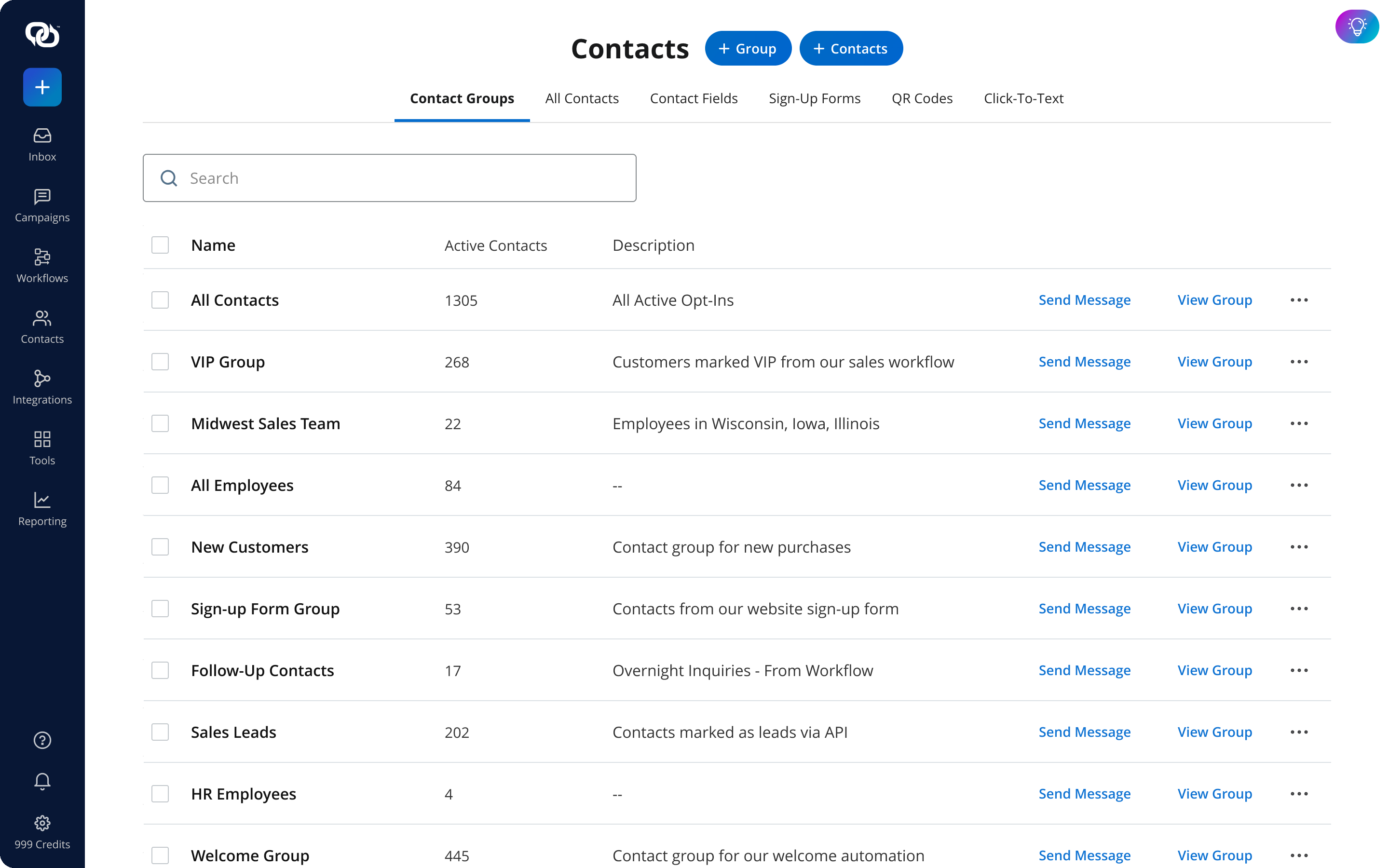
Quality of voter data determines who you reach and how. High-quality data produces high-quality communication, because it lets a campaign tailor messages to a voter's demographics, behavior, preferences, and location. Bad data wastes every send.
Timing can make or break outreach. Texting a voter at 2am, knocking at dawn, or messaging all day long will not get the response a campaign wants. Building a voter contact plan, including how far in advance to begin, keeps the cadence respectful and effective.
Personalized interactions and quality data go hand in hand. A campaign might use a voter's ZIP code to text their exact polling location, address, and hours. That kind of specific, useful message is what motivates action.
Technology ties it together. Volunteers can capture voter data on tablets in real time while an SMS platform turns that data into personalized messages at scale. Automation and workflows let a small team run a program that would otherwise require hundreds of callers.
EZ Texting's Position
Texting should be the core of any modern direct voter contact program, not an afterthought bolted onto phone banks and mailers. The channels that once carried campaigns are losing ground: fewer people answer unknown calls, and mail is slow and easy to ignore. SMS is the one channel still delivering reliable, near-instant attention from almost every voter, and it does so at a cost that lets even a small campaign compete. The winning move is not to abandon canvassing, which still delivers the deepest persuasion, but to lead with texting for reach and speed and let field work go deep where it counts. Campaigns that wait for a "big list" before they start texting are leaving turnout on the table.
EZ Texting is built for exactly this. With mass texting, two-way conversations, contact segmentation, scheduled sends, keyword text-to-join, and TCPA-focused compliance tools, campaigns can run a full political texting program from one platform.
Frequently Asked Questions About Direct Voter Contact
Direct voter contact is one-to-one communication between a campaign and individual voters, through channels like door-knocking, phone calls, mail, and texting. It matters because personal, direct contact is linked to higher turnout than passive advertising. Field research from Yale's ISPS and others shows that a real exchange with a voter moves behavior in a way a billboard or TV ad does not.
Texting and canvassing win at different things. Door-to-door canvassing delivers the deepest persuasion per voter but does not scale, while texting reaches thousands of voters instantly at a low cost per contact. Get-out-the-vote texts lift turnout by roughly 0.25 to 0.3 percentage points on average, comparable to mail and calls for far less money, and they work best on low-propensity voters. The strongest programs use both.
Yes, when done correctly. Campaigns must follow TCPA rules, which generally means texting voters who have opted in, identifying the sender, and providing a clear way to opt out (such as replying STOP). EZ Texting provides opt-in tools, opt-out management, and compliance features to help campaigns text responsibly.
Campaigns build opt-in lists through signup forms, event sign-ups, website prompts, and keyword text-to-join, where a voter texts a word like JOIN to a number to subscribe. Collecting explicit consent keeps the program compliant and improves engagement, because the people on the list have chosen to hear from the campaign.
Effective political texts include registration prompts, election and early-voting reminders, polling-place details, fundraising appeals, event invitations, and two-way conversations that answer voter questions. Each message should be personalized with voter data, timed appropriately, and focused on a single clear action.
EZ Texting gives campaigns mass texting, two-way messaging, contact management and segmentation, scheduled sends, keyword text-to-join, and compliance tools in one platform. That lets a small team run a targeted, personalized voter contact program at scale. You can learn more on the political texting page.
Add Texting to Your Doors and Dials
If your phone calls and door-knocking are not getting the engagement your campaign needs, it is time to add SMS. Canvassing still moves voters, door-to-door contact lifts turnout by roughly 8 points (Yale ISPS field experiments), and texting extends that same personal contact to every voter you cannot reach in person. EZ Texting helps campaigns connect with voters at scale, on the channel voters actually read. Get started today to see what texting can do for your outreach.
See other related to Industries:
See other related to Features:
See other related to Use Cases:
See other related to Topics: